Posts

A 21st Century New Deal

There are a lot of #coronavirus rebate policies floating around. My response considers these policies broadly. The policy we need must have elements that are universal, need-basis, and industry/occupation-targeted. Basically, we need a 21st Century New Deal. Most of the policies presented are income-based, and the worse are contingent on tax liabilities. The overwhelming majority ignore that need is created both by how consumers actually spend their money and how American workers make their money. Let me explain why such policies ultimately will be inefficient at plugging the gap in the long run.  Foremost, income-based policies ignore the choking reality of wealth inequality. Assets (e.g., savings, checking accounts) are the primary means people have to cope with financial crises. Yet, a sizeable portion of the American public has little to no savings but this is being completely ignored.  Moreover, most policies conveniently ignore the outstanding burden of deb...

You Can Call Me "Ali"

Dear Folx, I invite you into a new space that has provided me comfort. About six (6) months ago, I wrote my last blog as a writer without tenure. During that time, I asked people to start calling me "Ali", which is an Arabic root that means, "high", "elevated", "champion". People must have thought me completely obnoxious. "Call me `Ali'...like Muhammad Ali," I offer. Oh, ohhh, ok:  "Ali?!?" "Yeah, Ali," I respond. There is a soft rhyme in the name, "Abigail Ali"..."A.Ali"..."Dr. Ali". Call me "Ali". Ali, for me, is short for Alyasah, so you can know how to pronounce the name properly: Ahh--lee--ah--sah. Not, Al-Ya-Sah. Not, A-lish-a. Not, Ally-as-ah. Not, Ally, Al-lie. Call me, "Ali". Derived from "Aliaxa", my champion for infinity. How I got here from Abigail is a hard story to tell. It is a story of love, of grief, of misdiagnosis, of asylums, of p...

Pre-Tenure Anxieties

The evaluation period for my tenure file has begun. The letters have been written and sent in; the documents have been uploaded and updated; the dates have been set. Every school has a different process -- but at Emory University if you are in the College of Arts and Science, tenure is basically a three step process. First, the department votes on your file and constructs a letter summarizing how they feel about your candidacy. The complexities of your arguments are relayed to the next set of readers through their eyes and the eyes of the letter writers. Supposedly, that process happened yesterday afternoon for me. There are hints that it will be positive. That should ease my anxiety. Yet, here I am at 3:11am, trying to work out my anxiety through writing about the very thing that brings me anxiety -- getting tenure. Second, the department's letter and vote are sent to the "T&P Committee" for the Emory College of Arts and Science. This is a big group of people -- ...

20 Marks of a Criminal Record [Poem] - A Tribute to Devah Pager

20 Marks of a Criminal Record [Poem] -- A Tribute to Devah Pager (1971-2018) I have to  write:  Devah Pager died  of pancreatic cancer  two days ago, y'all —  a write up in the Times spells out an in-depth obituary of some type called,  “When a Dissertation Makes A Difference” —  Wow.  Pancreatic cancer.  I need to eat better,  one .  Which one  will take me out?  Two .  Why live?  Three.   Because you have so much  to give  with only one  lifetime to give it,  four .  It is ok  to feel these ways,  right now —  she was that enormous  for everyone,  five .  Why I have to be Ok  with getting up at 3am  and trying to write --  papers do not write  themselves,  six .  Because she still with us  through the work she created,  seven...

Seven Lessons of Financial Literacy 101: Or, If We Do Not Eat, We Cannot Write

Image
Pondering "dollah, dollah" bills right now, as I complete preparation for the first summer gig I have accepted since finishing my Ph.D. program in 2013. It's been four solid years, and I do not regret a moment off the summer income grind. The time typically spent prepping, in office hours, managing emotions, invoices, and PI expectations has been rerouted to strengthening my research in ways that are tractable and contributory. Sunday, however, I fly out to Albuquerque, New Mexico for a week-long course on race, methods, and health co-taught with the ground-breaking political scientist, John A. Garcia , and hosted by the RWJF Center for Health Policy at UNM . In mid-July, John and I team up again in Ann Arbor, Michigan via the RWJF-funded short course on health issues facing vulnerable populations hosted by the ICPSR Summer Program in Quantitative Methods for Social Research. This year, John and I will be joined by one of the leading sociologists of the Great Recession, S...

[Poll] What Kind of Researcher Am I?

As a health disparities researcher, I conduct theory-engaged, policy-relevant analyses of the political economy of ethnoracial inequality. — Abigail A. Sewell (@aasewell) May 24, 2017 Hi folks! I am hosting a poll on Twitter @aasewell as I prepare my materials for my re-appointment review. Can you help me out? Does the above description of my academic self best represent my research? What do you think? What needs to be modified or better specified? Check out this poll and let me know what you think in the reply comments.

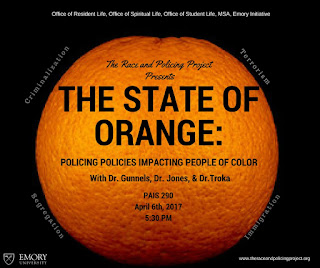
The Race and Policing Project presents "The State of Orange"

Image
It is my delight to return to the blogosphere with news from The Race and Policing Project. In the first week of April 2017, we will host our first public event ! We are still rounding up co-sponsors (feel to volunteer!), so the flyer may be updated closer to the event. Just wanted to get the word out there! Please visit our Facebook Event page and share the word widely!  The State of Orange: Policing Practices Impacting People of Color An Interactive Panel Thursday, April 6, 2017 5:30-7:00pm PAIS 290 On Thursday, April 6, 2017 from 5:30-7pm, The Race and Policing Project will present "The State of Orange: Policing Practices Impacting People of Color” in PAIS 290. “The State of Orange” is an interactive panel that will address surveillance practices shaping ethnoracially-marginalized communities through immigration, deportation, national security, and mass incarceration policies. In particular, we will highlight pedagogical approaches to addressi...